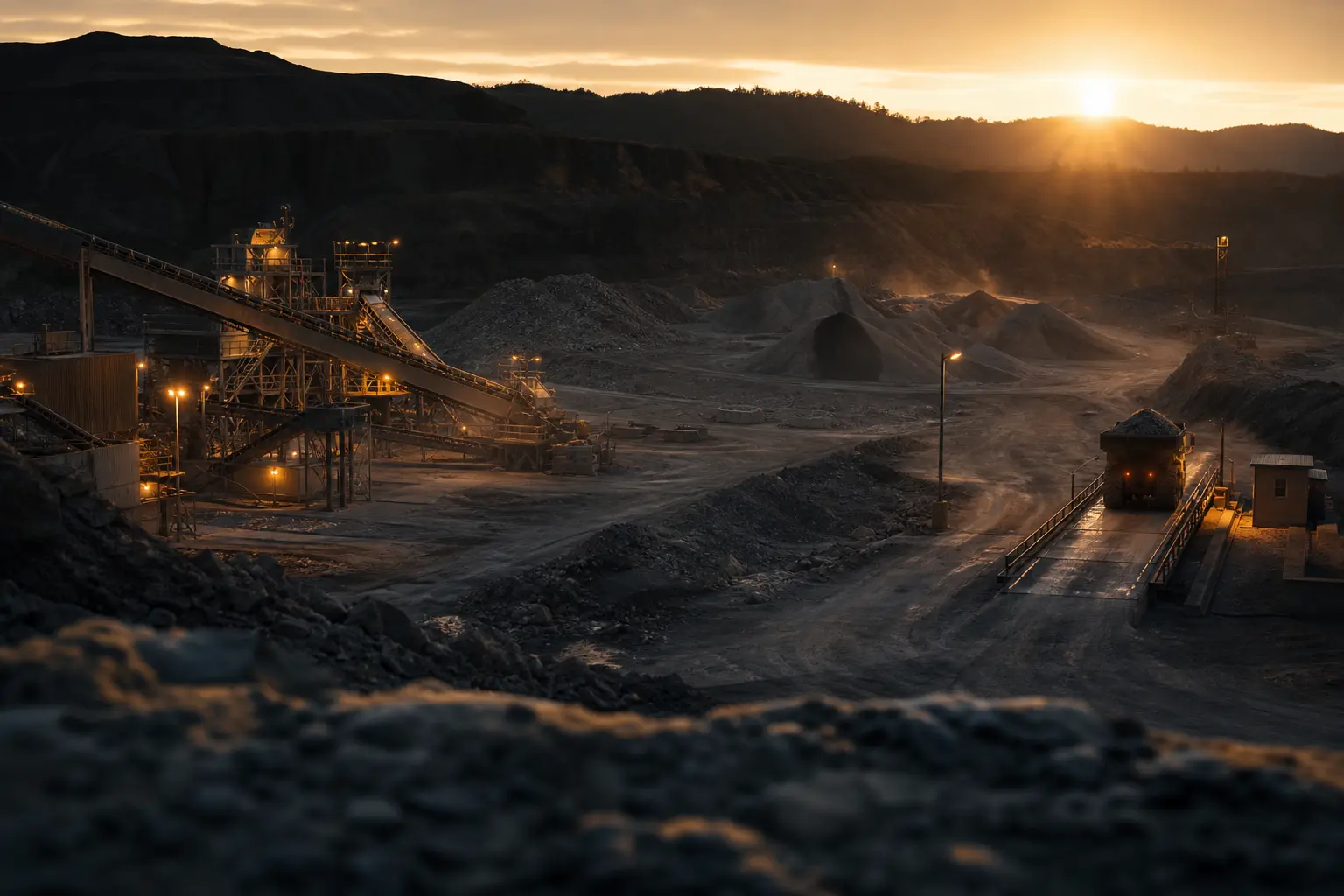
Aggregates is one of the least automated industries relative to its complexity. A mid-size quarry can run tens of millions in material through paper tickets, email orders, spreadsheets and a scale house system installed a decade ago. The technology gap is not in weighing trucks — that works. It is in everything around it.
This blueprint lays out the modules in the order they should be bought, and why that order matters.
The stack a typical quarry actually runs
The important observation: the scale system is a ticketing system, not an operations system. It does not read your email, reconcile your fiscal notes, measure your cutting line, or write your daily production report. That messy last mile is where the manual labour lives — and where automation belongs.
- Scale ticketing at the weighbridge — Apex/Command Alkon, Fast-Weigh, SMSTurbo, Scaleit W8, WeighStation
- Accounting — QuickBooks, Sage, or an ERP
- Excel and Google Sheets for everything the above two do not cover
- Email and phone as the real order-entry system
- Paper, PDFs and photos for fiscal notes, delivery slips and driver confirmations
Module 1 — Fiscal note and ticket automation
Every quarry has this problem and every quarry understands it, which makes it the right entry point. Documents arrive as email attachments, scans, photos from drivers and exports from the scale system. Fields are extracted — customer, product or grade, gross and net weight, tonnage, ticket number, truck, driver, job site, date, price, tax, cost centre — validated against price sheets and tax rules, and pushed into sheets and accounting.
Validation matters more than extraction. Sequence gaps reveal missing tickets. Duplicate detection stops double billing. Price-sheet checks catch the wrong product code. Anything uncertain goes to a review queue rather than into the books.
Module 2 — Reconciliation and billing packets
With tickets structured, reconciliation becomes mechanical: match tickets to orders and fiscal notes, flag duplicates, missing loads and weight mismatches with the evidence attached, and group matched tickets into invoice-ready batches per customer, job site and period.
This is the module that changes cash flow rather than just workload, because billing stops waiting for a manual month-end assembly job.
Module 3 — Email order intake
"Can you send 30 tons of 3/4 crushed limestone tomorrow?" is an order sitting in an inbox. Parsing product, quantity, date, job site and contact into a structured order — then notifying dispatch and drafting the confirmation — removes a transcription step and a class of mistakes at the same time.
Module 4 — Cutting line and guillotine production tracking
This is the differentiator, because nothing mainstream does it. Cameras over the line detect each produced piece, measure approximate dimensions, classify by size or grade and estimate weight from material density. Waste is derived from input block volume versus output. Cycle time is measured continuously.
The outputs are the numbers a quarry has never had: tonnage produced per shift, waste percentage per material, cost per ton built on measurement, output per operator, and maintenance alerts driven by cycle-time drift rather than breakdown. Processing runs on on-site hardware, so pit connectivity is irrelevant.
Module 5 — Daily production report
Tons produced and sold, inventory movement, downtime, maintenance notes and a trucking summary, compiled from tickets, logs and supervisor notes and delivered every morning. It is a small module that changes management behaviour, because a daily number that nobody assembles by hand is a number people actually use.
Modules 6–8 — Inventory, dispatch and customer portal
- Inventory: live stock position derived from production in, shipments out and periodic surveys, with low-stock alerts instead of monthly guesses
- Dispatch: truck-cycle-aware schedule suggestions, conflict warnings and automatic driver notifications, replacing the whiteboard and group text
- Customer portal: customers pull their own tickets, invoices, order status and quotes instead of calling the office
Why modular beats a platform
Quarries do not buy platforms; they buy solutions to named problems. A $4,000 module that ends daily retyping is an easy decision. A $60,000 platform migration is a project nobody has time for.
Modularity also protects the operation: each module is proven in a shadow run, adopted, and only then extended. And because each module produces structured data, the next one is cheaper to build than the last.
What we do not touch
Weighing, blasting, plant control and safety-critical systems stay where they are. Automation belongs on the information layer: documents, email, production records, reporting, billing and communication. That boundary is what makes it deployable in a working quarry without risk.